

1-888-DGVO-PRO (348-6776) (EST) | 647-339-1322 (mobile) david@davidgilbertvoiceover.com
How to Hire a Voice Actor with Actual Impact

How to Hire a Voice Actor with Actual Impact

Beyond the “Nice Voice”: How to Hire a Voice Actor with Actual Impact

You have the perfect script, the editing is tight, and the visuals are stunning. But then, you add the voice-over, and something… deflates. The project sounds good, but it doesn’t feel anything.

This is the classic pitfall of the voice-over casting process.

We often start with the wrong question: “Who has the best voice?” Instead, we should be asking: “Who is going to make my audience feel exactly what they need to feel?”

Choosing the right voiceover talent isn’t just about selecting a pleasant tone or specific characteristics. It’s about finding a storyteller. If you want your project to resonate deeply, rather than just delivering information, you need a different approach to casting.

Here is how you, as a client, can move beyond the surface-level polish and hire a voice actor who will deliver genuine emotional ROI.

1. The Rookie Mistake: Hiring a Voice, Not a Storyteller

In my experience, the most common mistake clients make is focusing exclusively on the vocal quality—the timbre, texture, and deep resonance—while overlooking the actor’s connection to the script.

Anyone with a decent setup can “read” words off a page. But if they’re just reading, the end product is hollow and disconnected. Your audience is smart; they can sense when a narrator is emotionally disengaged, inauthentic or worse, full of B.S. When that disconnect happens, your message becomes meaningless.

You are not just buying sound; you are investing in an interpretation that drives your audience to do something, think something, or feel something. The moment the voice becomes more important than the message is the moment you lose that connection.
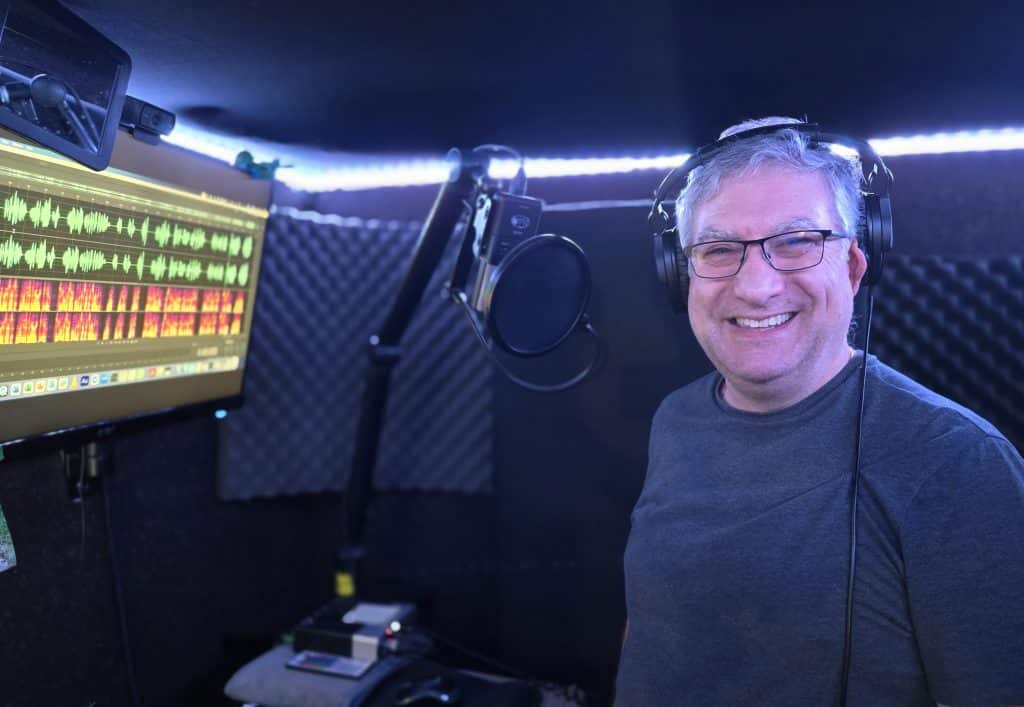
David Gilbert pictured smiling in his recording booth

2. The Emotional Litmus Test: Casting for the “After-State”

Context matters more than tone. A deliverable needs to be either “presentational” or “conversational,” and that choice dictates the energy of the read.

When providing direction in an audition or brief, don’t just ask for “friendly” or “authoritative.” Specify the exact emotional response you want from the listener.

I encourage clients to include this specific direction:

  • “We want the audience to feel [Inspired / Motivated / Determined / Entertained / Compelled/etc.].”

This is the ultimate litmus test. When you listen back to auditions, you’ll know immediately who is just “voicing” the copy and who has connected with the purpose of the message. You’ll feel it, just like recognizing talent in a gallery painting. If they can make you feel that emotion during a simple audition, they will make your audience feel it in the final product.

3. Spotting the Red Flags in a Voice Actor’s Demo

When you are sifting through demos, you are looking for evidence of emotional range and professional rigour. A great demo isn’t just about sounding slick; it’s about showcasing storytelling capability.

Here are major red flags that suggest an actor will struggle to connect meaningfully with your project:

  • Poor Technical Quality: If their demo has poor audio quality or poor mixing, you have no guarantee they can deliver broadcast-ready files for your final project. This is a baseline requirement in the world of home studio recording.
  • The “Same Note” Syndrome: Listen carefully. Are all their demo spots (e.g., a commercial read vs. a narration read) delivered in the same style, pace, and emotional tone? If they can’t shift gears, they can’t adapt to your specific script; they are just applying a static “voice-over filter” to everything.
  • Lack of Emotional Depth: If all the spots are purely “retail” (focusing only on sales data, prices, or “buy now” information) with no examples of deeper narrative, they may struggle with storytelling.
  • Too Much Projecting: Good voice acting is often intimate. If the talent is always “projecting” and “announcing” directly at the mic, they lose the ability to create a genuine connection.

boy screaming into a voice over microphone

4. The Collaborative Partner vs. The “Hired Throat”

The voice itself is only half the battle. The other half is the interaction and professionalism. Some of the most underrated factors in a voice actor’s ability to deliver success happen after the contract is signed.

I find that clients get the best results when they look for a collaborative partner rather than just a narrator. Ask yourself (and their references) these questions:

  • Are they actually directable? In a live-directed session, can they take and interpret directions well? Or do they just give the same performance over and over?
  • Do they add value? Are they a creative thinker? Are they willing or able to help with script analysis/updates or assist with casting for other types of voice talent?
  • Are they professional? This includes being responsive, helpful, reliable, dependable, and delivering with a fast turnaround.

A voice actor who understands script analysis or can pivot creatively during a session saves you immense time and stress, essentially acting as an extension of your own creative team.

5. Strategy: Cutting Out the Middleman for the Project’s “Soul”

You might find talent on a Pay-to-Play (P2P) site, or you might find them through a boutique agency. Frankly, the location of discovery is less important than the interaction that follows.

While P2P sites offer convenience for casting thousands of voices at once and simplify billing, they have a massive downside: you, as the client, must sift through a sea of mediocre or poor-quality auditions to find the great ones.

Whenever possible, I find that working directly with the voice buyer is best.

Working one-on-one allows the actor and the client to “own the relationship.” You aren’t fighting platform restrictions, restrictive messaging interfaces, or hidden administrative costs. When you cut out the middlemen, communication becomes seamless. Direct collaboration is the most efficient way to ensure the final product retains the “soul” you set out to create.

Conclusion

While it’s very easy to do, try to stop thinking of voice-overs as a final accessory for your video or content project. The humanity of a human voice can truly make or break the message.

To choose the right artist, look past the pleasant tone. Cast based on emotional impact, test their storytelling ability in the audition, prioritize their soft skills like directability, and whenever you can, foster a direct relationship. When you find that true collaborative partner, you won’t just hear the difference—your audience will feel it.


Do you know what problem you solve?

Do you know what problem you solve?

Do you know what problem you solve?

As a voice actor, voice over talent, voice over artist, voice talent, voice artist or any other variation, it always was something I couldn’t put my finger on.

Yes, we are storytellers, yes we convey information to an audience, yes we train people, delight people, and entertain people. We even greet people when you call.

We “do” a lot of things for our clients and their projects.

We narrate scripts into a microphone, which gets converted to ones and zeros into a digital file and transmitted electronically.

That is what we “do,” but not what problem we solve.

Ultimately, every project starts with someone passionate about something that they want to convey to an audience, so they start writing down words.

Those words come together as a script.

It can be vetted, proofed, approved, critiqued, edited, adjusted, and ultimately agreed upon before we ever see it.

Their intention is to get those words into their target audience’s head (information), heart (motivation) or soul (inspiration).

Sure, anyone can read words on a page.

But only voice talent have trained, studied, coached and practiced how to “say” those words in a believable way so the intended audience “believes” what they are being told.

Connecting the dots – from the script to the audience’s head, heart, or soul – IS the problem we solve.

Yes, all the obligatory phrases you hear are still relevant (telling your story, storytelling, spreading your message, or anything else similar), but in essence, if you can’t make that connection, everything else is irrelevant.

What’s your take on this?

What Is Voiceover and What Can I Use it for?

What Is Voiceover and What Can I Use it for?

Voiceover acting started with Reginald Fessenden in 1906. He was the first person on radio to transmit voice messages out to ships at sea during Christmas.

Following shortly, Walt Disney voiced the Mickey Mouse character in the short animation Steamboat Willie. This marked the advent of Mickey Mouse’s long-standing success on screen and boosted the cartoon toward becoming one of the most famous animation characters in the world today.

The Warner Brothers company was not far behind. Together with Leon Schlesinger Productions and Mel Blanc as the starring voice actor, Looney Tunes was born. “The Man of a Thousand Voices”, as Mel was rightfully nicknamed, began a successful career in voiceover acting, breathing life into famous characters like Bugs Bunny and Tweety Bird, among others.

Mel Blanc set the standard for voiceover acting pretty high, also managing to secure on-screen credit for his voice roles. Other voice actors had not received the same benefit until Blanc demanded his rights and set the stage for those following in his footsteps.

So, what is voiceover and how can this service help modern businesses flourish?

What Is Voiceover?

Voiceover is the art of lending one’s voice to various visual-based projects. A voice actor is a professional that generally has some form of training in the field or someone that has raw talent in changing his voice to imitate or invent voices for film characters, radio, or television.

Voiceover is used in animated feature films, animated short films, TV commercials, TV shows radio spots, foreign film dubbing, video games, audiobooks, puppet shows, radio dramas, and so on. This skill is used in many industries all over the world and in almost every language imaginable.

Waiting rooms, public transport, elevator, and other public announcement systems also employ voiceover artists for their needs. Voice actors perform various types of voices and are sometimes even asked to sing.

More recently, voiceover is also heavily used in e-Learning and other types of online learning modules. Newer still, voiceover apps have started popping up. Although they’re pretty basic and raw, demand will often push development further and we’ll start seeing these types of apps increase in quality over time.

Here are the main types of voiceover acting performed today:

  • Commercial: this type of voiceover is used for TV, radio, online advertising, and film.
  • Character: character voiceover is used for animated feature films and cartoons.
  • Narration: a narrator is a voice that relays information to the audience, somewhat detached from the life of the characters, unless the narrator is also a character in the film, documentary, cartoon, or other voice-powered production.
  • AI-generated: these voices are generated by computer software and can be used for film, radio, gaming, etc.
  • AI-modified: similar to AI-generated voiceover.
  • Automated dialogue replacement: this type of voice acting is used post-filming to improve voice quality in a film or animated feature. It can also be used to record over voices with thicker accents.
  • Automated announcements: used in subway announcements, phone answering automated services, and other public announcements.
  • Translation: This voiceover technique is used for dub localization, which basically means recording over a foreign language.

How to Choose a Voiceover Actor?

As previously mentioned, many industries employ the help of voice actors for various types of productions. The biggest niches to use this type of service are film and television, gaming, and translation or dubbing production houses.

Choosing the right type of voice for your voiceover project depends on a few important factors. Of course, it makes sense to first have a script that the voice actor could use to practice making up a new voice for your character.

Still, details like what age is the character, what are their likes and dislikes, do they speak with their mouth full, do they get angry and scream, do they sing, do they tell jokes, do they have a squawky voice or a thick accent? There are tons of questions you can brainstorm through before figuring out what you want your character to sound like.

More importantly, perhaps, is choosing a voice talent that is flexible and can try out different types of voices before settling on one particular one. This beginning experimental part can prove to be quite funny and enjoyable, and the actor should indeed feel free to play around with how they hear the character sounding in their own head.

It can be challenging to agree on a certain type of voice. But, make sure you don’t get stuck on particularities and be open to receiving input and considering the suggestions of your actor too. Being too strict can mean a lot of time wasted on auditions that never reach the level of voice finesse you envision for your character.

If you are serious about matching the best possible voice to the right character, some grunt work is certainly required beforehand. You’ll want to define the voice of your brand/script, make sure you create a backstory for your character, and of course have a storyboard for visual aid during auditions. The more information you provide for the actor, the most likely it is that you’ll get good delivery.

Be aware that too much information can give the exact opposite result. You don’t want to overwhelm your actor unless you want to hear them speaking in tongues.

What Are the Costs of Voiceover Service?

After you’ve done your homework and flexibly defined what you’re looking for in a voice actor, it is time to start searching for talent. You’ll find that there are thousands of voice acting professionals and this might make your job of choosing one, or a few, harder.

To avoid feeling overwhelmed, try to go for a voiceover actor with intermediate experience. Going too low could mean extra training and work to get the actor to where they need to be, and too high could cost you a pretty penny. Your budget, of course, needs to be taken into consideration when choosing your voice talent.

Most voice actors will charge by the minute or by word count. Starting at 2 minutes and going all the way up to 30 minutes of recording, the fee can begin at around $250 and settle at around $1000+. This price range depends on the individual actor’s fees and can fall lower or higher of this estimate.

Conclusion

Voice auditions can be fun but tiring. Short-listing a few good voices can be a challenge but well worth it in the long run. Choose a voice actor after you’ve figured out what works for your production. Voiceover might sound like a simple thing to pin down but it could be more challenging than you think. Thus, ensuring that the actor has all the details necessary for them to create the right voice is imperative.

How to Find the Right Voice Over Talent for Your Project

How to Find the Right Voice Over Talent for Your Project

As someone who needs a voice over talent or voice actor for the first time for a project, or who hires regularly, finding the right voice over talent for your project can be a daunting task. For first-timers, this can be especially challenging as like anything you’ve never done before, you lack the experience to know what to look for. If you’re a seasoned pro, hopefully, you’ll take away some nuggets you never thought about before.

Let’s take a look at the process.

First – Understand Who You’re Looking For

This first step will save you a lot of time and potential aggravation (not that you need any more at this point in your project). You need someone who will make your life easier, not harder; this is where a professional voice over talent will be your best bet. But how can you tell if they are actually a “professional” and not someone with a USB microphone recording in their bedroom?

Key indicators your voice talent is a professional:

  • Records in a sound treated booth
  • Has a professional mindset with a customer service focus
  • Focussed on making your life easier
  • Can record whenever it is most necessary for you
  • Believes in collaboration

Key indicators your voice talent is an amateur:

  • Doesn’t have the proper equipment, training, or recording space
  • Thinks of you as only a “paycheck” and not as a partner
  • Limited business experience
  • Unwilling or unable to be responsive and helpful for your needs

It also helps to have as much information nailed down as to the specs of the project you are working on including all the “w’s” so it will be easier for the voice talent to provide an accurate quote.

Second: Time to Start Searching for Your Voice Actor

The absolute worst thing you can do is to type in “voice over” into Google if you want to search for a voice over talent. You’ll get all kinds of wasted results – including anything and everything to do with VOIP (voice over internet protocol)! Ughhhhh!

If you are comfortable searching directly, trying terms like “male voice over talent,” “male voiceover,” “male voice talent,” “professional male voice over,” “professional male voice over talent” (or the female/gender varieties) may be a good place to start. You’re more likely to find search results showing websites of voice over talent than other unrelated search results. Other qualifiers you may wish to add to your search query are:

  • The genre: ie commercials (TV, Radio, Web), explainer/whiteboard videos, eLearning video narration, corporate narration, animation, telephony – eg. “male voice over talent for eLearning”
  • A specific industry: ie retail, banking/finance, automotive, learning & development, etc. – eg. “male voice over talent for retail commercials”
  • A specific style/tone: ie authoritative, conversational, friendly, baritone, resonant, warm, sincere, energetic, etc. – eg. “male voice over talent conversational commercial”
  • Or any other specific terms relevant to your needs, like a language, accent, dialect, etc. – eg. “male voice over German accent”

There’s really an unlimited number of search options but at the end of the day, you’ll only need to focus on those that matter most to your project. The more you can narrow down your search, the better!

One place to start for quality talent is World Voices Organization (WoVO). WoVO is the only member-driven organization for voice over professionals BY voice over professionals. You can search their member directory of vetted professionals at https://www.voiceover.biz/.

Third: It’s Demo Time!

Now that you’ve found a voice over talent or voice actor, how do you know they’re the right fit for your project? One of the first steps is to listen to their demo(s). Typically, a well-thought-out voice over talent’s website will have their demos easily found and playable on the front page of their website. If it’s not, run!

Having said this, these can be glitzy, well-produced demonstrations of the actor’s abilities and it may sometimes be a challenge to gage their fit for your project based on the demo alone.

One way to get around this is to request a custom audition where the professional voice over talent will submit a sample read (up to a minute) of your script.

This helps in two big ways:

  • It lets you gage more accurately if their vocal qualities are a fit for your project, and
  • Let’s you hear the quality of the audio they can produce. If there are any distracting sounds, clicks, hiss or anything else, that’s a signal to look elsewhere.

When sending in a request to a talent for a custom audition, it’s always best to include as much information on the project as possible (as it would also be needed for any quotation – the next step). At the custom audition request, information such as tone/style of read is what you’re after – but this can be tweaked prior to moving into production.

Fourth: How much will all of this cost?

To answer that question – among many others – it’s important to nail down all the other details that will come into play. Questions you may have for the voice over talent and questions they will have for you.

Some, but not all, of the areas that would need to be clarified include:

  • The nature of the script/project
    • is it a one-off video or a series of videos?
    • one commercial or part of a campaign
    • how long is the script/video/training program?
  • where and how will it be used
    • internal company broadcast
    • global campaign or just in your small-town radio station
    • company social media pages with limited followers
  • how long will the project be used, eg one week, 3-month campaign, 1 year, or buyout (which means forever and a day)
  • what is your budget – this is key for the voice over talent to know as most credible talent will do everything they can to work within your budget
  • will you want to or need to either listen in or fully direct with the talent during the recording session (and if so, by which means – phone patch, Source Connect, Skype, etc.)
  • delivery deadline – this is key to have upfront so both parties are on the same page – is the audio file due the same day, up to 24-hours, 48-hours, 1 week, etc.
  • and file specs required (ie mp3, AIFF, wav) – though only relevant once the project is agreed upon

As we are all independent contractors, every voice actor will have their own internal rate card with their own factors in determining their final price per project. As you can see, there are quite a number of factors that can influence the price you pay, but like most things in life, you get what you pay for. There are a couple of industry accepted rate guides out there that are a good starting point for rates (including the GVAA Rate Guide and the Gravy for The Brain Voiceover Rate Guide are the most respected non-union rate guides). But these are just starting points.

And ultimately, the final rate becomes a negotiation between you and the voice actor. I know for myself, my whole philosophy is wrapped up around building long-term relationships so it doesn’t make any sense to lowball a quote just to come back later and raise prices or ask for an above-market rate simply because I want to make more money.

Collaboration is the goal. When you and your professional voice actor are on the same page, working well together, at a price that is agreeable to all, it should be a smooth and stress-free relationship. Because the last thing you want to do is to keep going through this process every time you need a voice for your projects.

And it’s not just the “voice” you need, but a solid partnership. Someone who will actually go beyond what is asked. Providing constructive feedback on script revisions if needed. Voluntarily offering to make referrals to other professional voice actors if there is a need for a different sound, gender, language, accent, etc. and making the referrals if necessary.

So finding the right talent for you, your project, your brand, and your company is paramount to your success.

Please contact me anytime if there is any project you are working on where you need a voice – the right voice over talent – and we’ll talk!

What’s the Difference Between a Voice Actor and a Voice Over Talent?

What’s the Difference Between a Voice Actor and a Voice Over Talent?

What’s the difference between a Voice Actor and a Voice Over Talent?

Seems like an odd question but depending on who you ask in the industry, it could mean a lot.

According to the dictionary I grew up with, Merriam-Webster, a “voice actor” is defined as “an actor who provides voice-overs or who voices characters in animated films, video games, etc.” So, if you don’t provide characters in animated films, video games or the like, are you then still considered a voice actor or a voice over artist?

Ironically, “voice over talent,” “voice talent,” “voice over artist,” “voice artist” or their variations aren’t listed in the dictionary.

Consider the Genre

If you provide narration voice over for corporate videos, e-Learning voiceover or training video narration, would you be considered a voice actor (voice over actor) or voice over talent? Again, depends on one’s perspective. Since the voice talent/actor is not playing themselves in these genres – including commercials – there is still a need for acting ability to make those narrations believable to the listener.

However, the demands for an actor (which again, according to Merriam-Webster defines as “one who behaves as if acting a part”) would appear greater in dialogue-based performances than narrative ones. (Though I can hear my audiobook brethren shrieking in outrage by that statement as they would in all likelihood say there is a tremendous amount of acting required for audiobooks – which I have no doubt given the complexities of fiction audiobooks).

An e-Learning voiceover can be from the perspective of a company leader, department head, or even a colleague imparting either helpful tips or urgent compliance information. A narration voice over for a corporate video would generally be regarding something the company is proud of (an achievement), historical journey, or to inform, educate or inspire about a new product, service or new corporate direction.

Either way, the voice over talent needs to assume the correct role (who) of the person speaking, fully understand what they are saying, who they are saying it to, why they are saying it, and even when and where they are saying during the voice over narration.

Video Game Voice Over

Considering genres like video games, animated series or movies where the “content” of the narration is primarily dialogue, most would argue you need to be a good actor first before becoming a voice actor.

Without good acting skills and abilities, you wouldn’t be able to bring those characters to life in a believable way. How should a toy spaceman with build-in wings who thinks he’s more powerful than he really is sound? What would a space alien battling army dude sound like when he’s talking to his commander? Definitely more than just reading words off a page.

Commercial Voice Acting

A commercial voice actor, on the other hand, may or may not be playing as richly developed a character as you’d find in a video game for, say, a commercial voice over about financial services. And yet, a commercial voice actor many times will have to believably portray a multitude of fictional characters in 15, 30 or even 60-second mini-movies, clearly and believably imparting an emotional point of view relating to the product, service or organization telling their story.

Also, if the commercial voice over is not presented in a believable way, the intent of the commercial will lose its impact and not be as effective for the advertiser. Have you ever listened to a radio or TV commercial and not “believed” what they are saying?

And audiences have grown weary of the old-style “announcer,” preferring to hear words spoken in a very conversational way. Believe me, narrating someone else’s words – especially very “salesy” scripts – in a conversational way is not an easy task!

Looking around at other genres from training video narration, explainer videos, whiteboard videos, telephone system messaging/IVR (interactive voice response) systems, museum tours, transit system announcements, voiceovers for toys, apps and even film and TV dubbing, it’s clear there is a wide spectrum of “acting” abilities required by the voice over talent (or voice over artist).

Ultimately, a voice over talent shares many of the same skillsets with a voice actor, but at the end of the day, it all comes down to this; does the audience “buy” what the voice over talent or actor is selling. If they are believable in the role they are paid to play, then that’s all that really matters.

David Gilbert immersed himself in the wonderful world of voiceover after a 20+ year career in sales and marketing. He brings business acumen, marketing experience, and solid work ethic to every audition, project and client interaction. Call David to discuss your next voice over or narration project.